Capability-Aware Safe Meta-Decision in Physical AI-Driven Robotics: A Try-Ask-Refuse Framework
2026.9 – 2031.8
NRF
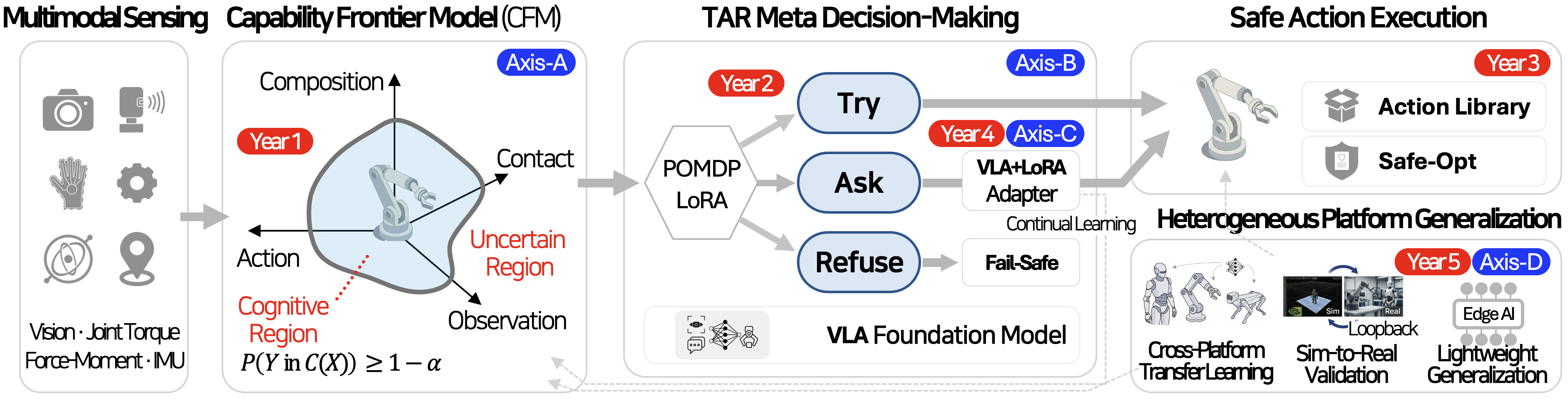
A framework that lets a physical AI robot judge its own capability before acting, and then choose among three meta-decisions — try the task, ask a human for help, or refuse it — so that unsafe or infeasible commands are declined instead of attempted. Supported by a 2026 Basic Research Grant, funded by the Ministry of Science and ICT (MSIT) and managed by the National Research Foundation of Korea (NRF). The project will run from September 2026 to August 2031, with a total budget of KRW 250 million over 5 years.
Try-Ask-Refuse framework: multimodal sensing, the Capability Frontier Model, TAR meta decision-making, and safe action execution across heterogeneous platforms
Cross-National AI Mobility: Joint Korea–Japan Research on Cross-Domain Perception and LLM/VLM-Based Multimodal Decision Systems
2025.8 – 2026.8
NRF
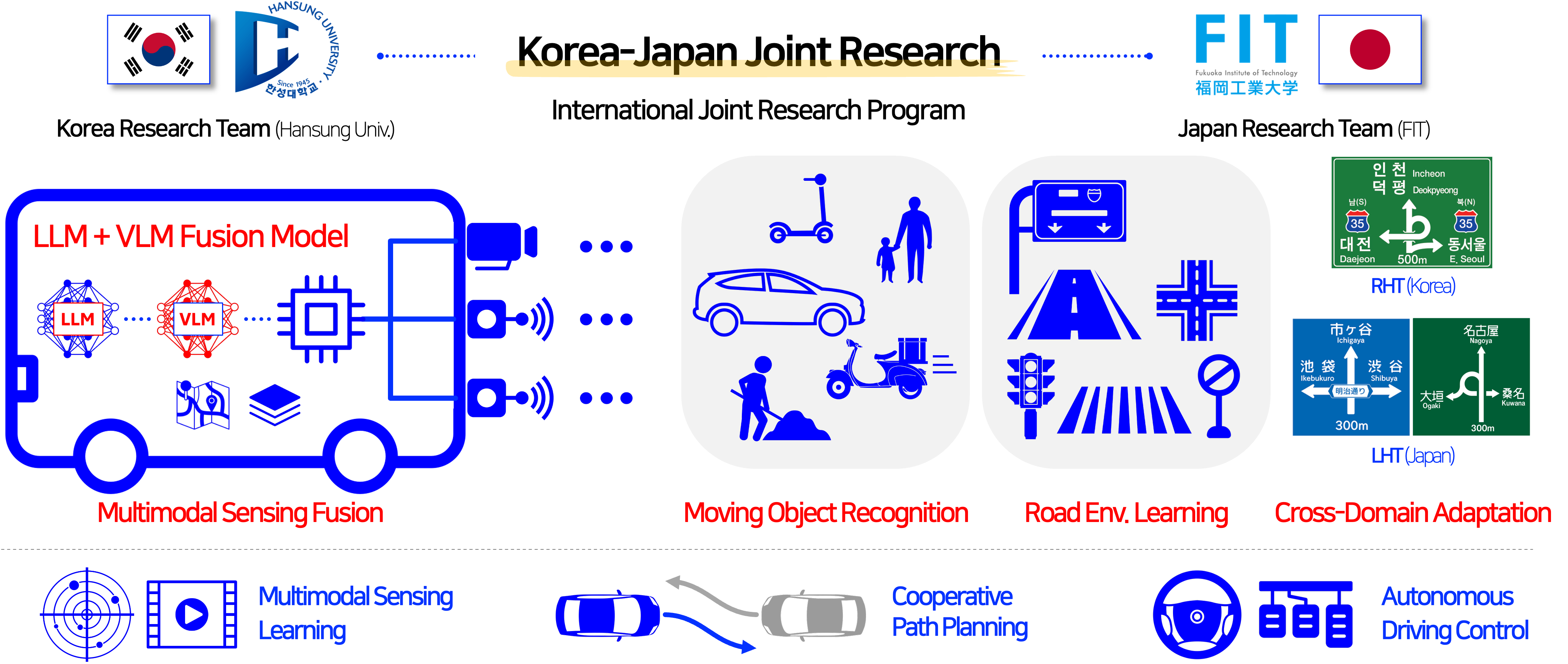
A joint Korea–Japan research effort on cross-domain perception and LLM/VLM-based multimodal decision systems for AI-driven mobility.
Cross-domain perception and multimodal decision-making for cross-national AI mobility
Research on Security Authentication Technology for Automatic Charging and Payment of Electric Vehicles
2022.9 – 2024.2
Hansung University
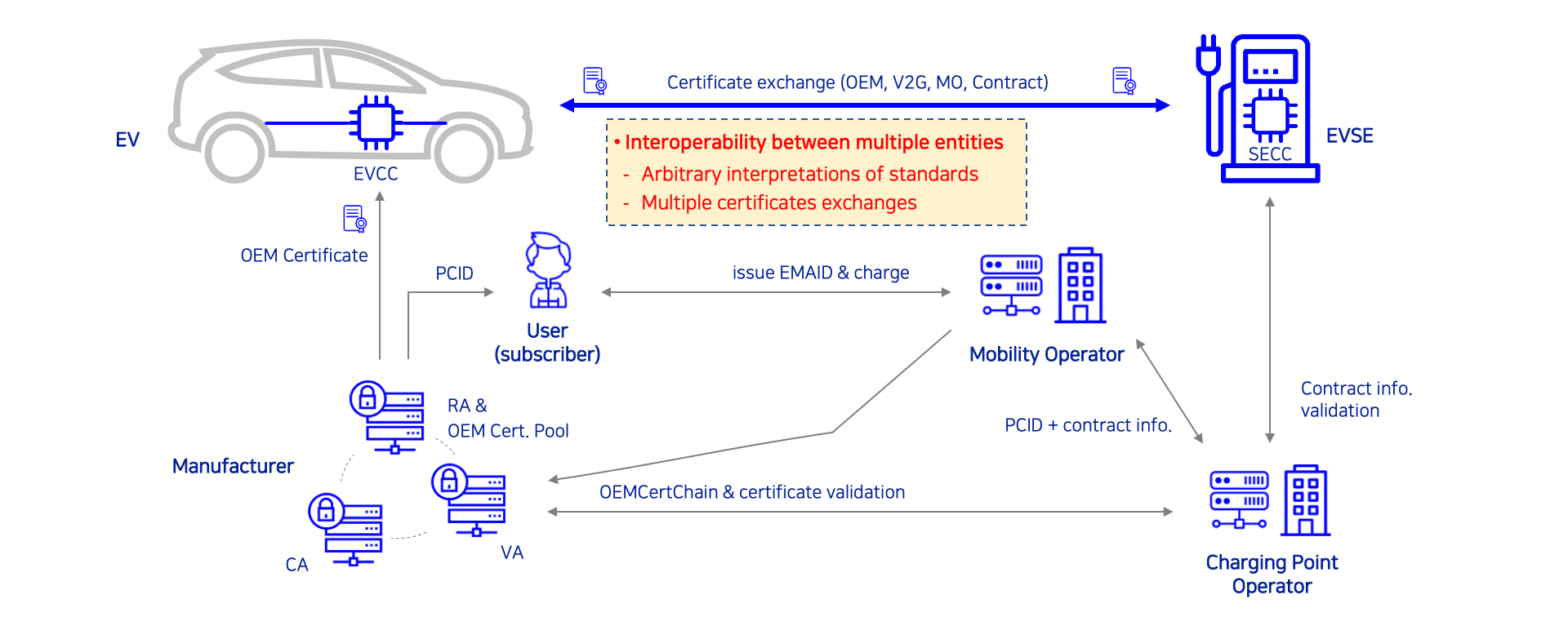
Authorization for EV charging and automatic payment based on ISO 15118, using a Plug and Charge public key infrastructure with X.509 certificates.
Plug and Charge based on ISO 15118
Research on Moving Objects Recognition Technology for Autonomous Driving Collision Avoidance Control
2022.9 – 2024.2
Hansung University
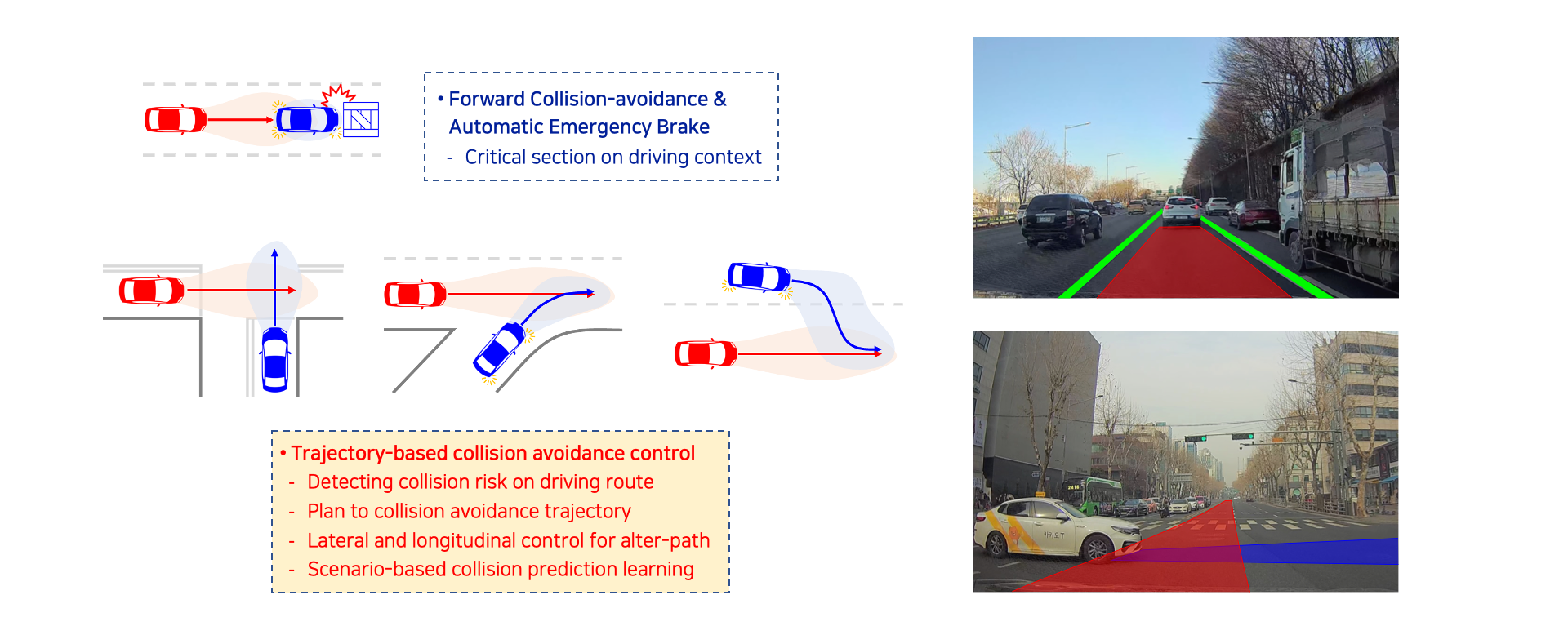
Prediction of the movement and interference of moving objects in the driving trajectory, supporting collision-avoidance control for autonomous driving.
Collision avoidance for autonomous driving
Modeling Research for Multi-link Operation of Wi-Fi 7
2022.9 – 2024.2
Hansung University
Performance modeling and analysis of multi-link operation in Wi-Fi 7, including data division transmission and multi-AP coordination.
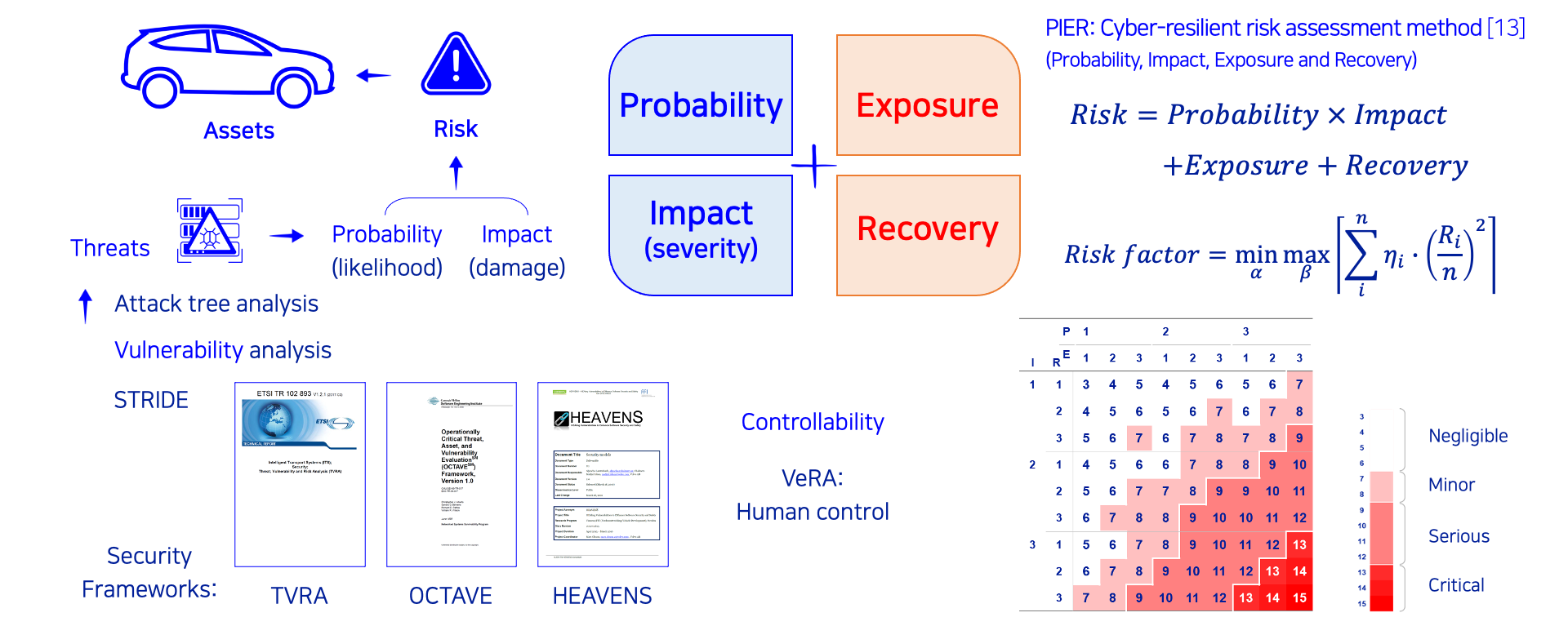
Research on Automotive Cybersecurity Threat Analysis and Risk Assessment Methodology
2021.9 – 2022.8
Hansung University
Risk assessment from cyber threats, vulnerabilities, likelihood and damages on target vehicles. The PIER approach considers cyber-resilience: beyond the risk factors of probability and impact, it also covers exposure and recovery.
The PIER method for TARA
Collaboration
We welcome joint research and industry collaboration on automotive cybersecurity and
intelligent mobility. Please contact Prof. Seunghyun Park at
sp@hansung.ac.kr.